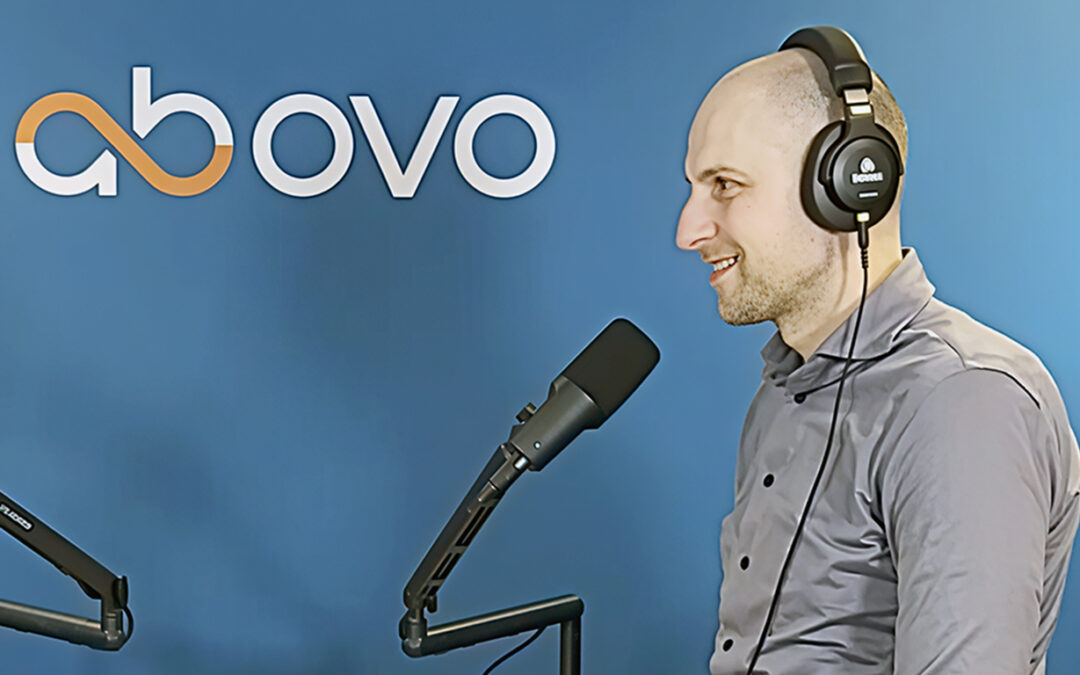
Inside the offices of Ab Ovo, conversations about the future of software have started to sound very different. Less about coding syntax and technical specifications, and more about speech, interaction, and human communication.
In a new episode of Studio Ab Ovo, we sat down with guest Dieter Veldhuis to explore one of the company’s most ambitious ideas yet: the movement from speech to software.
What followed was not just a discussion about technology, but about how AI is fundamentally changing the way people think, work, and collaborate.
“The digital landscape changes every day”
Interviewer: Welcome, listeners and viewers at Studio Ab Ovo. Today I’m joined by Dieter Veldhuis. We’re talking about IT, the future of IT, and the exciting movement from speech to software.
Dieter Veldhuis: Thank you. Yes, within Ab Ovo, our strategy has been focused on developing a speech-to-software platform for several years now. It’s become a core part of our vision, and we’re all actively working on it today. What makes it especially exciting is how rapidly AI developments are accelerating what’s possible.
But it’s important to understand that speech-to-software isn’t just one single tool. It’s an entire ecosystem of components and technologies working together.
Dieter explains that the speed of change in the digital world can easily distract companies from their long-term goals.
Dieter Veldhuis: Every day, there are new AI startups, new tools, and new possibilities. For an IT company, the challenge is staying focused. Everybody wants to experiment with the newest technology, but that can also disrupt your strategy if you’re not careful.
For us, our speech-to-software vision actually helps us stay on track. It acts almost like a compass in a very fast-changing landscape.
Turning conversations into visual business processes
One of the most practical components of the speech-to-software vision is something Ab Ovo calls the BPMN Wizard.
Interviewer: What exactly does that bring to Ab Ovo?
Dieter Veldhuis: Interestingly, it brought value in ways we didn’t initially expect. We originally created it to support software development itself, but we quickly realized it could become a standalone product.
Dieter explains that BPMN — Business Process Model and Notation — is essentially a visual representation of business processes.
Dieter Veldhuis: Traditional software specifications can become very long documents. They’re difficult to read, and different stakeholders often interpret them differently. Customers read them one way, analysts another way, developers another way again.
That’s where visualization becomes so important. A visual process often communicates far more clearly than pages of written documentation.
The BPMN Wizard automatically generates those process visualizations from spoken conversations or text input.
Interviewer: So instead of manually creating all those process diagrams, the system generates them automatically?
Dieter Veldhuis: Exactly. You can still create them by hand, of course. But imagine simply talking to the system — or uploading text — and having the entire business process visualized automatically in real time.
“What if documentation becomes real-time?”
The conversation moves toward one of the biggest frustrations in traditional software development: documentation.
Dieter Veldhuis: Normally, analysts visit a customer, discuss processes in workshops, collect functional requirements, and then go home to write everything down afterward. That results in long specification documents.
Then the customer has to review those documents and verify whether everything was understood correctly.
Interviewer: Which is exactly where things can go wrong.
Dieter Veldhuis: Precisely. You have asynchronous communication. Someone explains something, another person interprets it later, writes it down later, and then someone else reviews it later again.
But what if you could do this synchronously?
With the BPMN Wizard, conversations can immediately generate visual process flows during the discussion itself.
Dieter Veldhuis: Stakeholders can instantly look at the screen together and say: “Yes, that’s exactly what we mean,” or “No, we missed a step there.”
That direct interaction removes many of the misunderstandings that traditionally happen in software projects.
Different industries, different languages
The interviewer points out that even when people speak the same language, they often still misunderstand each other because they work in different industries.
Interviewer: An IT specialist and a client may technically speak the same language, but professionally they’re speaking completely different languages.
Dieter Veldhuis: Exactly. And that’s why visualizing processes becomes so crucial.
Dieter explains that manually creating business process diagrams used to be too time-consuming for many organizations. Drawing every process component by hand simply took too long.
AI changes that completely.
Dieter Veldhuis: Now we can generate these process visualizations directly during conversations. That changes the entire dynamic of software development.
Beyond software development
One of the biggest surprises for Ab Ovo was discovering that the BPMN Wizard had value far beyond software engineering.
Dieter Veldhuis: We started talking to companies outside traditional software projects. Large organizations with multiple international offices became interested because they realized processes differed significantly between locations.
Headquarters often assumes every branch operates the same way — until they actually visualize the workflows and discover major differences.
The tool also attracted interest from accountants, consultants, and companies focused on process optimization.
Interviewer: So it’s almost becoming a kind of business intelligence tool for processes?
Dieter Veldhuis: You could definitely describe it that way. It’s like business intelligence for process definitions.
AI, trust, and change management
As the conversation deepens, the discussion naturally turns toward trust and human behavior.
Dieter Veldhuis: Everybody is still learning how to work with these tools. Even internally at Ab Ovo, we’re still transforming the way we work.
People are used to old habits — writing things down manually, avoiding recordings, documenting everything afterward instead of during the conversation.
Some people still find AI-assisted recording uncomfortable.
Interviewer: Because it can feel a little out of control?
Dieter Veldhuis: Exactly. Although at the same time, recordings also create transparency. You can always replay the discussion and verify what was actually said.
Still, security is essential. Business processes often contain sensitive intellectual property.
That is why Ab Ovo developed secure environments where companies can safely use these tools without exposing confidential data externally.
“Even children already understand this naturally”
Toward the end of the interview, the tone becomes lighter.
Interviewer: Is it difficult for users to get used to working this way?
Dieter Veldhuis: Actually, it’s surprisingly easy. The interface is very intuitive. There aren’t many clicks involved, and there’s a learning module built directly into the platform.
Honestly, children probably understand this interaction model faster than adults do.
Dieter laughs as he compares AI interaction to watching children use modern televisions.
Dieter Veldhuis: Adults still press buttons on the remote control. Kids simply press the microphone button and say what they want.
“Start YouTube.”
“Open this channel.”
That’s naturally where speech-to-software begins.
“This is only the beginning”
As the interview comes to a close, Dieter emphasizes that the BPMN Wizard is still only one component of a much larger vision.
Dieter Veldhuis: We’re encouraging companies to start experimenting with it now. Several organizations are already using it and giving us very positive feedback.
What excites us most is that we’re only at the beginning. Every week we discover new ways people want to use the tool — sometimes in ways we never originally imagined ourselves.
For Ab Ovo, speech-to-software is no longer just a futuristic idea.
It is already starting to reshape how software, business processes, and even conversations themselves are created.